Meaning of Tarkovsky's Stalker {spoilers]

A discussion on Tarkovsky’s Stalker - and the possible meaning of its story.

Tarkovsky’s masterpiece Stalker recently screened at a theater in Los Angeles and I was able to stay awake for it’s entirety.

My first attempted to watch Stalker was on my bed with a laptop, and about half an hour in… I woke up for the credits.

28150id_018.jpg

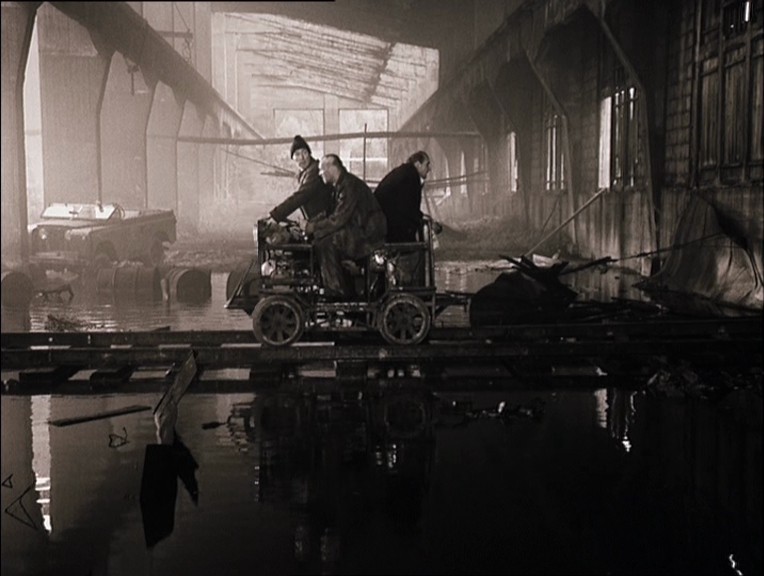
Before you go judging me, watch it and tell me if you don’t yawn a couple of times over the fifteen minute shot when the leads drowsily take naps.

Maybe it was the 64 ounce caffeinated beverage I was sipping, or the socially awkward silences and creaking seats that kept 600 of us holding our breaths so as not to ruin the mood - but the tension was real, and I was riveted to the screen this time, and learned a cuss-load about awesome filmmaking.

I’ve read a bit of Tarkovsky’s stuff in the past and here is a quote of his:

“I don’t do symbolism, I do story.”

He never said that exactly - but he meant it, and oh man can he pull it off.

So first go watch the movie Stalker… then ask yourself, “What did I just see?”

And don’t fall into the trap of symbolism… Tarkovsky hates direct parallels with anything… he calls it shallow preaching, bad filmmaking and detests it in his or other’s films.

andrei_tarkovsky_stalker_01_0.jpg

So if the crippled daughter, the wandering dog, the reoccurring images of syringes don’t directly mean something… then what was their point? Why are they there? Again, what was the point of what we just saw?

While all of those objects matter and are intentionally put there by Tarkovsky —the direct A equals B symbolism is never as impactful as the subtle emotional story that he weaves. To him symbolism is a shallow attempt at good art.

So to answer “What was Stalker about?” I pose the following list of questions.

I beg you to answer them yourself. My answers will follow.

Depending on your starting point, your world view, or your belief systems there is a chance our answers will be the same, and a good chance they will differ and both could simultaneously be correct interpretations, another sign of masterful art; it touches you where you are at.

But don’t be fooled by your answers, he was trying to say something. The master artist always is attempting to express him or herself.

In this case things are so intentional, so perfect you’d be a fool to say Tarkovsky isn’t trying to “equip your soul for good” - another poorly paraphrased saying of his by me.

(See Questions Below)

QUESTIONS to ASK YOURSELF following a viewing of TARKOVSKY’S STALKER.

28150id_009_w1600.jpg

1. What is the purpose of the journey our three adventurers go on?

2. What does the Room supposedly give you?

3. Who goes into the Room during the film?

4. Why don’t the heroes go into the Room?

5. How does the movie start?

6. Again (think hard), does anyone go into the Room?

Next there are two speeches at the climax of the movie that must be discussed.

7. The Stalker’s speech. Point of discussion: Why did the Professor and the Writer lack faith?

8. The Wife of the Stalker’s speech. Point of discussion: What did happiness through sorrow mean to the wife? and was marrying the Stalker the right thing to do?

And some final questions (you’re doing great):

9. What is this movie about in one word?

10. What are we given (shown) at the very end?

11. Was your desire fulfilled from going into the Room?

12. Does this depend on your heart? (If this last question is confusing read on.)
(My Answers follow)

1*QIlBKZrBsZG5IYeMb4E37w.jpeg

My ANSWERS:

(Again please watch and answer the above questions before reading below.)

1. What is the purpose of the journey our three adventurers go on?

To find the Room.

2. What does the Room supposedly give you?

Your heart’s true desire.

3. Who goes into the Room during the film?

Your initial answer might be no-one… but wait!

4. Why don’t the heroes go into the Room?

The Writer doesn’t want to see what his heart’s true desire actually is, he would rather sit in his nice house complaining than to actually look into his soul. Remember the warning about the old Stalker who went into the Room to heal his brother but came out rich instead, and then committed suicide when he realized that he wasn’t as noble as he thought.

The Professor was actually there to destroy the room, going into something far beyond what he could explain is something he never wanted.

The Stalker doesn’t go in because a ‘stalker’ isn’t supposed to go in. This is the unspoken law of those who can lead others to the room. Ie. The example given above about the stalker that did go in… it ruined him.

5. How does the movie start?

Funny question you might say… but very important to see whose perspective the movie belongs too… It’s us - the viewer. We walk slowly into a room through those beautiful antique doors to see the sleeping family.

6. Now to ask again does anyone go into the Room? (Hint: the Room fulfills one’s true desires.)

images.jpeg

We do. Remember the shot looking back on the three travelers, worn out, the Professor throwing pieces of the bomb? We are in the Room as the audience looking back at them — and the Room will give you your heart’s true desire. Were you granted yours? A trick of the artist here is that the proof of the Room, the faith in it’s reality, is always at question. The heart of most viewers while on the journey to the Room actually want to know if there is a power, a magic. Should we believe it, or is it a sham. We therefore ask the same questions the characters ask throughout.

Next there are two speeches at the climax of the movie that must be discussed.

7. The Stalker’s speech. Point of discussion: Why did the Professor and the Writer lack faith?

They lacked faith because they have become so numb to the world, numb to taking risks, numb to living; so that their muscles of faith have atrophied to the point of non-existence. This is the point of the Stalker’s worn out frustrated speech -- that brings the Wife to speak - to us (the audience). She speaks directly to us!

8. The Wife of the Stalker’s speech. Point of discussion: What did happiness through sorrow mean to the wife? and was marrying the Stalker the right thing to do?

Stalker Wife.jpg

First off, why is she speaking to us? Because we are the ones on the journey! Suddenly what she says to us becomes key to hear what the master Tarkovsky is longing to share with us in his parable.

Happiness through sorrow is the point. Marrying the man with faith, joining together with faith doesn’t make the journey perfect but it makes it worth it.

And finally:

9. What is this movie about in one word?

I would argue faith. Not an abstract faith, but for purposes of the story -- faith in the Room (that it is a true judge of the heart, with the power to grant wishes).

10. What are we given (shown) at the very end?

The Cripple daughter moves items through telekinesis. A power beyond. Magic. A Miracle.

andrei-tarkovsky-stalker-19792.jpg

11. Was your desire fulfilled from going into the Room?

Did you see the magic that speaks of a power beyond? Do you have faith? Were you granted to believe in what this story and I would say Tarkovsky was begging you to believe in… that the Room was real.

...and is there a crossover or application in our actual world?

Tarkovsky made film to inspire the soul - to equip the audience to love more.

Was he trying to tell us we need faith, faith in miracles, faith in love, faith in God to do this?

12. Does this depend on your heart?

I’ll leave this to you.

- bryan lee

0s1XA4mypsCXiYO_H.png

7 Promotional Videos types to increase revenue for your business

It’s no secret that videos have become a dominant part of online marketing and promotional strategies. In 2017, 50% of all mobile web traffic is now dedicated to watching videos. In other words, if online video is not part of your marketing strategy, your message will be missed by a huge portion of potential customers.


10 years ago, you would have needed a 6 figure budget and a tv commercial to reach an audience, but this is no longer the case. Online videos don’t have the same time constraints, and budgets can be significantly more flexible. Whatever your needs are, you can bet that there is an online promotional video style that is right for your organization. 


Here are 7 of the most popular types of promotional videos we’re seeing on the web.


1) Animated Explainers

Screen Shot 2017-09-12 at 5.26.17 PM (2).png

The goal of these videos is to explain your product or solution in the simplest, most straightforward way possible. You can highlight the benefits of your offering in a way that everyone can understand.


The challenge is to keep things simple, your goal is create a 3-minute video that explains what might normally require a 30 minute presentation. The advantage, of course, is that you don’t have to pay for actors, create sets, or find props. You will need a good artist and editor, a voiceover, and of course, a clear concise script. Here is an example from Tait Communications:


https://www.youtube.com/watch?v=Hp78T5YyHC0


2) Case Study/Testimonial

In the information age, customers increasingly want to know what others think about your product. While reading reviews is great, seeing someone on screen actually tell their story adds a depth and realness to their testimonial. 

Screen Shot 2017-09-12 at 5.35.02 PM (2).png


The most common challenge is finding customers who love your product so much that they are willing to give up their time to appear on camera. But if you know of any advocates, then results are worth it!


3) Behind the Scenes

One of my favorite things to watch growing up were the Behind the Scenes videos of Disney World. Who knew they had tunnels beneath the entire park?!


You may not be Disney World, but that doesn’t mean your company isn’t interesting. What do you do that is unique? Do you work with any interesting people? Essentially, you’re inviting potential customers into your “living room.” While you may worry about giving secrets away, going behind the scenes is a great way to build customer trust by showing off your people. We recently created a unique Behind the Scenes video for Hawaiian Airlines in which staff, all around the business, were introduced to Marmite.

https://www.youtube.com/watch?v=cZK1h_hHJqo


4) Training Videos

Screen Shot 2017-09-12 at 5.32.13 PM (2).png

Training videos are an incredible way to build your organic search traffic. Most people today don’t want to read a manual, they want to watch a video! If you teach people how to use your product, you’ll help existing customers enjoy your offering more, and you’ll entice potential customers when you show them how your solution can help solve their problem.


It’s important that training videos don’t become commercials, teaching is your priority. A great strategy is to teach people about a popular topic that is relevant to your business. For instance, if you sell car parts, teach people how to change tires. If you provide power as a Utility, teach people how to conserve power. This is exactly what Mitre 10 does with their Guides and Advice page.


https://www.youtube.com/watch?v=S8lkD0C7fR0


5) Product Launch

Screen Shot 2017-09-12 at 5.30.50 PM (2).png

Got a new product? Great! Now it’s time to tell everyone what actually makes it great. The typical strategy is to interview the people who are behind the product. Designers, product managers, engineers, visionaries, builders, and anyone else who can provide input. Cover the interviews with as many shots of your product as possible, and show people the benefits.


The video should explain why you developed the product, what problem(s) it solves, and how it will benefit the customer. Nobody does these better than Apple. 


Screen Shot 2017-09-12 at 5.28.00 PM (2).png

6) Vision Video

If you’re targeting C-level customers, then you should know they’re more interested in the future of your business than the specifications of your product. A vision video explains where your company is going in an engaging and exciting way. You invite people into a better future, and give them confidence that their future will be bright, if they choose to work with you.


Rocket Lab is a New Zealand space company, and in the video we created for them below, you can get a real sense of the vision from their CEO. 


https://vimeo.com/121637617

7) Sponsored Creative

Want to go viral? One of the best ways is a sponsored creative video. With these, you partner with an established youtube entertainer. After providing a brief, they will make a funny video that loosely relates to your product or solution, then, at the end of the video, they’ll mention you as a sponsor.


While it may not give people the same amount of information as a product launch, it has the chance to be seen by significantly more people. One great example is “A Conference Call in Real Life.” The video was sponsored by an event called Leadercast and received over 14 million views! While your sponsored creative video may not reach 14 million, it can still reach a huge number of people.

https://www.youtube.com/watch?v=DYu_bGbZiiQ

What are you waiting for?

Quality video gives your organization, product, or solution a real professional edge over the competition. It also introduces you to a much larger audience. The reality is, you can’t afford not to be creating promotional videos for the web.


While you may not have the resources or knowledge to create video content in-house, that’s ok. There are agencies around the world who can partner with you to create content for your organization that fits your style. If you’re in the Auckland, NZ area, then contact us at Dreams in Shadow to discuss your video needs. We have extensive experience in the film industry, and are passionate about creatively bringing your story to life. We’d love to hear from you!

3 Good Reasons to Host Interns

intern

noun ˈɪntəːn/
1. a student or trainee who works, sometimes without pay, in order to gain work experience or satisfy requirements for a qualification.

To run a production company, especially as a start up, often means working more hours than humanly possible. I often ask others when was the last time they stayed up all night, and the answer is usually college. My answer is usually last week, and it was for work.

While taking an intern sounds like a nice way to get some help, it actually requires a lot of work from our end. It involves training someone who will probably not be here in the long run, taking time to invest in someone and give them advice, and then patiently watching them make all the mistakes you've made.

I often ask myself, why do we keep hosting interns?

The Fun (damentals) 

The Fun (damentals) 

We’ve worked in the video production business in Auckland for five years, and over that time we’ve taken on eight interns. That’s right, eight interns, but only three still work with us. If I were to add up the hours spent training them? Wow... countless. So again, why do it?


First reason: People matter.

This may sound simple or cliche, but in the long run, jobs or creative endeavors are always about people. When you care for people, you can expect to be cared for in turn. We love to pour into and guide our interns, but it’s always fun when they actually bless us with insight, a creative idea, a needed kind word, or future work! Investing in people has led to countless positive returns for us, and so, we keep taking interns.

Second reason: Passion.

We need reminding of why we do what we do! Interns are typically young, and youth is full of passion. If someone is willing to work for free - then they are doing it because they love the work.

In a world where work is all about what the company owes the employee, it is so REFRESHING to have someone present who wants to focus on learning and doing what they do - because they are excited about it. I can’t stress this enough - in every intern I see a piece of myself first starting out. Their presence is invigorating!

Third reason: The Fundamentals.

The Joy of the Intern!

The Joy of the Intern!

Like with every sport, trade, or craft, mastery is built upon the basics. If you always have an intern present - who you are constantly teaching the fundamentals of your craft to - you will remember them, incorporate them more into your work, and build off of them like every expert has done before. To teach is to learn.

Those are the top three reasons we host interns here at Dreams in Shadow. There are many more, and I have lifelong friendships with many of the Interns we’ve hosted. If you are one of these passionate people looking to get into video production or film please don’t hesitate to get in touch. Likewise, if you want a film made for your organization and want to support the intern development program we’re running, please contact us.

Bryan Lee Hudkins, Director Dreams in Shadow Ltd. 

It's a Wonderful Life: 3 Reminders of Great Screen Direction

SPOILER ALERT: (Wait, it’s 70 years old, never mind)

I've seen it a hundred times, but recently I included an It's A Wonderful Life virgin in my annual viewing of Frank Capra's holiday classic . As I thought about how he might be receiving it, one of the things that struck me about the film is how modern it feels. My friend was one of those individuals that occasionally has issues with older movies: "Oh, is this in black and white?" This led me to think about why this movie doesn’t feel like a 70 year old film.

Here are, perhaps, a few reasons:

Active Reaction Shots

Everyone knows how important reaction shots are. These are the shots that cut-away from the main action or character to reveal the reactions of another character watching. They emphasize an emotional arc of a character through the observations of another character. They help slow down a scene to make sure you get the crux of it, ensuring you didn't miss a fleeting line or a quick shot of action.There were a few examples from IAWL that wonderfully display the effectiveness of the reaction shot, yet takes them even further.

A few scenes into the film, after George is given the task of delivering poison, young Mary sits at the drugstore counter. She watches the boy, who "she will love 'till the day she dies", get reprimanded by his boss, Mr. Gower. Mr. Gower smacks young George on his bad ear. Cut to Mary jumping as she hears the slap on the side of his head. This way we get it twice. We have empathy for George of course, and with a single insertion of a cut-away shot, our empathy is expanded to two characters that we will quickly learn to love.

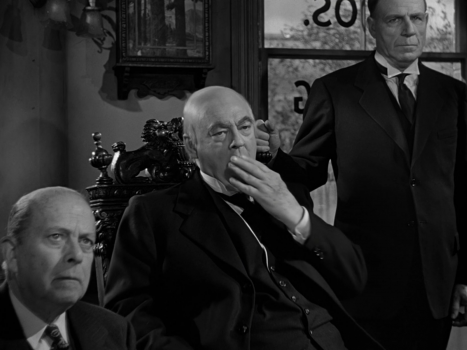
Another wonderful little shot is a reaction shot to Potter. Of course Capra does a great job introducing us to "the richest and meanest man in the county". But in the scene where George defends his caring attitude to the rabble of the town, and questions Potter's contempt for them, a cut- away reveals Potter covering his mouth to feign a yawn. A simple cut away to Potter listening, or eye rolling in the midst of listening to George's speech would have been effective, but I love his yawn. First, it motivates an edit because it is an action, but also communicates once again the character of Potter. He is bored with, and tired, of hearing these socialist ideals spouted continuously from the Bailey's. As we will see later, this weariness will lead him to do whatever he can to destroy the Building &Loan.

Another one of my favorites is Nick's reaction to Clarence and his status as an angel. This example may seem to go against the category of Active Reaction, but not when you consider it a set-up. George and Clarence are ordering drinks at “Nick’s” Bar after George’s life has been taken away. As Clarence tells George all about his "angelness", Nick watches from the other side of the bar with a stone cold stare, until he can't bare it anymore and throws them out. In true comedic fashion, Capra is setting up a joke here. And, in order for our hero being kicked out of a bar to be amusing and not depressing, a cut-away to the statuesque Nick, allows for the action-filled reaction of him kicking the both of them out. It's hilarious.

Slow Down Important Moments

It's all to easy to skip over important moments when shooting a scene, and then even later in the edit when you are concerned with boring the audience. The real trick is knowing when to slow down and when to move things along. When you get that down, you can start thinking about how to slow those important moments down.

Early on, we begin to feel the tension and frustration felt by George, as he is once again hindered from following his dreams of world travel. Harry is finally back home to take over the family business, but at the dinner table, George’s father asks him if he’d consider staying to continue operating the Building & Loan. In the midst of this shocking offer, Annie the maid interrupts their conversation. It’s just a pause in the scene, but it gives us a chance to catch up. “Did he just say what I think he said?” And, perhaps, it even gives us enough time to wonder how George will respond. He does respond, and let’s his feelings known to his father, setting up the crucial conflict that will carry the plot forward from that point.

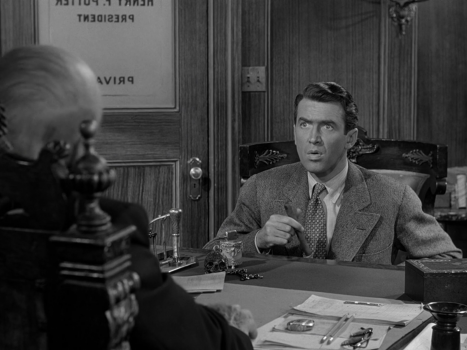
Later on, when George’s frustrations come to head with an apparent way out, Potter offers him a job. At first, it seems like George will finally give in to his life-long adversary, and take hold of the opportunity to achieve his dreams of experiencing the world outside of Bedford Falls. Of course, that would mean bowing to Potter, and abandoning the town’s people who have learned to rely on him. Pleased with the offer, but requesting time to think it over he shakes Potter’s hand. And he holds it, and looks at it, and then looks inside of himself. Capra has once again given us enough time to recall all of the events of George’s past so as to calculate what must be going on in George’s head. Finally, George wakes up, and stands up to Potter by refusing his offer, ashamed of himself for even considering it.

Also, to track backwards a bit in the same scene, I love the decision to have George drop his lit cigar in his lap upon hearing Potter’s unbelievable offer. Again, we have just enough time to chuckle, but also calculate what this opportunity will mean for George and his family. These are the little things that set the pace, and keep the audience in the story, not only as fly-on-the-wall observers, but as empathetic compatriots with our friend George Bailey.

Don’t Just Say Things, Break Things.

When people are frustrated, they complain. When they are at their wits' end, they break things.

For the first half of the film, Mary’s story has been tangental. Although she reveals her intention to love George ’til the day she dies in the opening scene, her presence in the story seems nothing more than yet another source of George’s dissatisfaction. Mary makes another advance on loner George after Harry’s wedding party. To her dissatisfaction, he confirms her biggest fear: George does not want to be married. All is lost. As he storms out of the house, and her mother encourages her courtship with Sam “Hee-Haw” Wainwright, she is at her wits' end, and smashes the “Buffalo Girls” record to pieces. It is at this point that Mary becomes more than a side character. Her emotions are charged, and we empathize with her. Our frustrations can only now be erased if and when they finally get together. And, in a cathartic relief a few moments later, we are ecstatic when they finally do, but the pleasure in that moment would have surely been lessened if she has simply let that record play on.

Later, as George’s life is falling apart, as he waits for the authorities to come haul him off to jail for losing eight thousand dollars, he regrets everything his life has come to be. He regrets having so many kids, and being forced to bring them up in a broken down, drafty house. In the midst of these regrets, he finally accepts that his boyhood dreams will never come to pass. However, he does not say this, he shows us. He shatters a model bridge set up in a small corner away from the kids, presumably a hobby he has picked up to hold onto that boyhood dream in a small way. It’s over; it will never happen for him. And, at the moment, he has nothing else to be happy about. Of course, after being given his gift of perspective from Clarence, he comes to realize how wonderful his life is. Although his childhood fantasies never came to pass, the life that eventually happened to him was indeed amazing, and one that he could be thankful for.

Although I don’t think these moments can be considered ground-breaking, then or now, these simple choices in scene direction are wonderfully efficacious in adding spice to the narrative, and they help transform “Its a Wonderful Life” from a nice little Christmas movie into one of the most inspiring films ever made.